Climate Data for Latitude 17.25 Longitude -95.75

Köppen climate classification: Aw (Climate: equatorial; Precipitation: winter dry)
 

Locations

Download
Sierra Norte de Oaxaca II

Averages (English) Metric

TypeUnitsJanFebMarAprMayJunJulAugSepOctNovDecPeriod
Min Temp57.158.461.464.566.466.865.766.165.963.860.157.7109 years
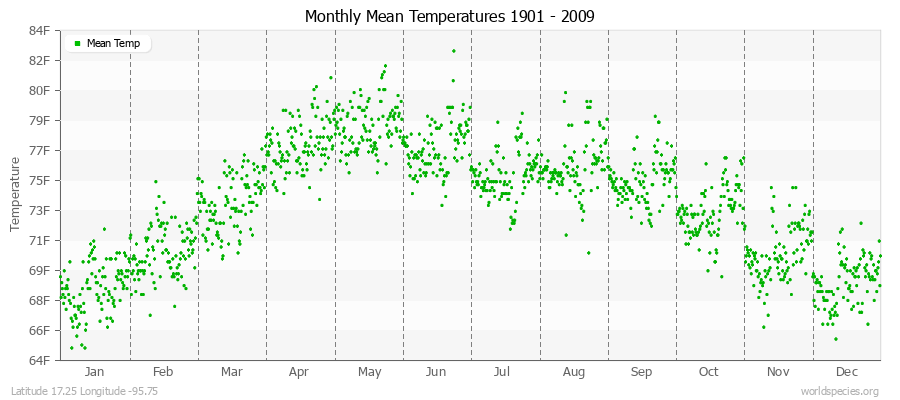
Mean Temp68.370.573.577.178.377.075.275.874.973.070.568.7109 years
Max Temp79.682.885.789.790.287.284.785.784.182.381.079.7109 years
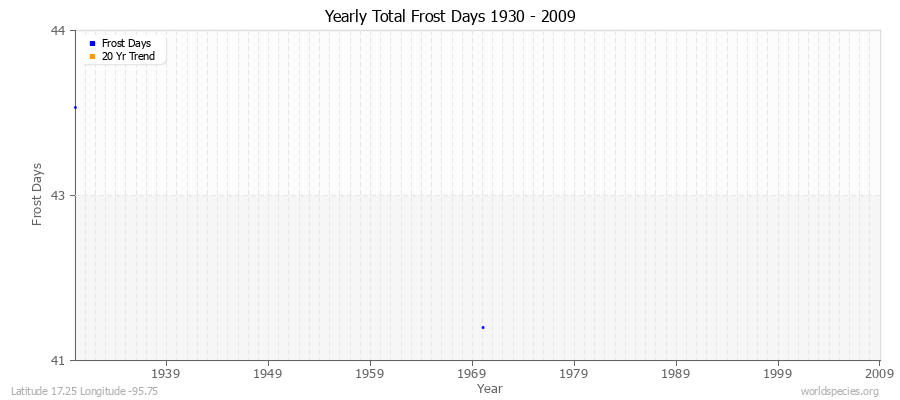
FrostDays1.60.91.71.65.53.05.51.52.04.16.38.62 years
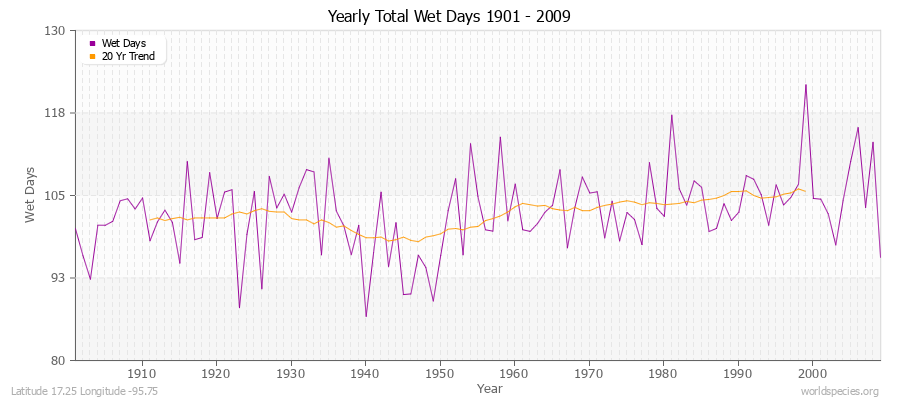
WetDays2.52.41.91.93.214.627.013.417.911.03.13.5109 years
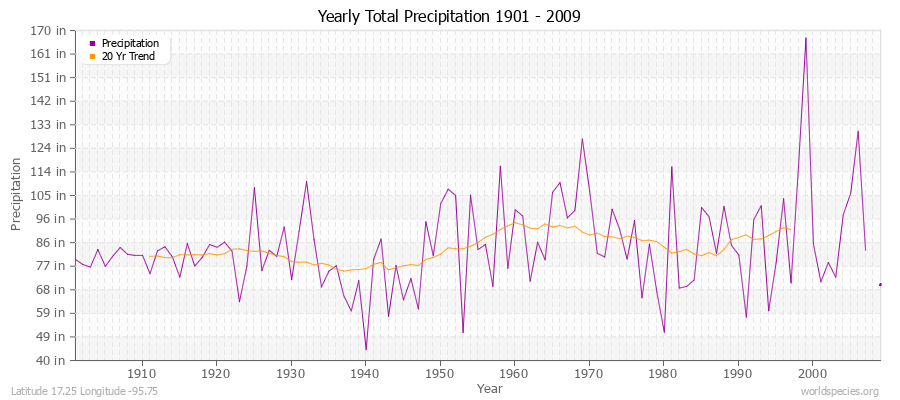
Precipitationin1.51.21.11.44.314.818.014.513.98.03.72.3108 years
Potential Evapotranspirationin2.93.44.24.34.63.93.94.03.33.43.12.8109 years
Yearly Average Temperatures 2010 - 2009 (English) Latitude 17.25 Longitude -95.75
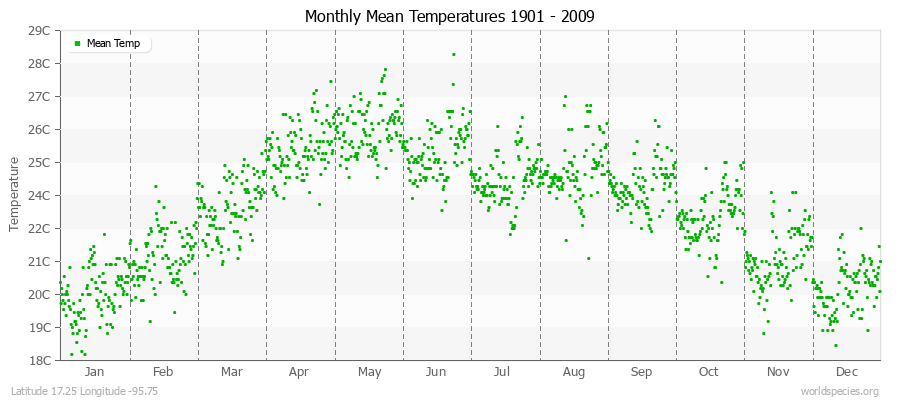
Monthly Mean Temperatures 1901 - 2009 (English) Latitude 17.25 Longitude -95.75
Yearly Total Frost Days 1930 - 2009 Latitude 17.25 Longitude -95.75
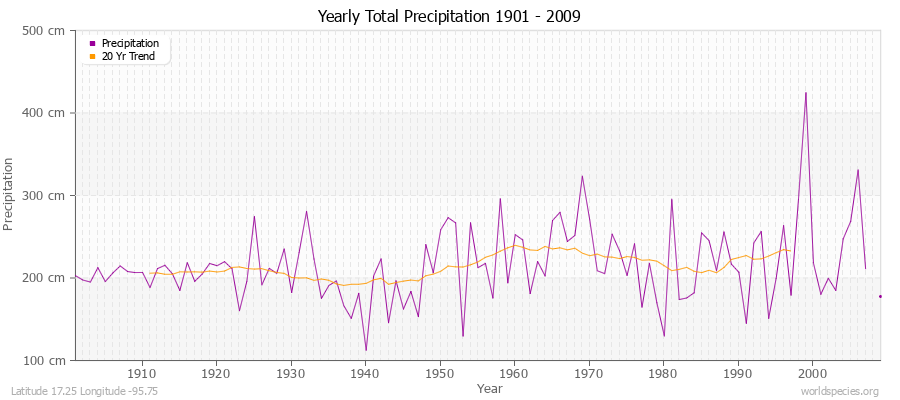
Yearly Total Precipitation 1901 - 2009 (English) Latitude 17.25 Longitude -95.75
Yearly Total Wet Days 1901 - 2009 Latitude 17.25 Longitude -95.75
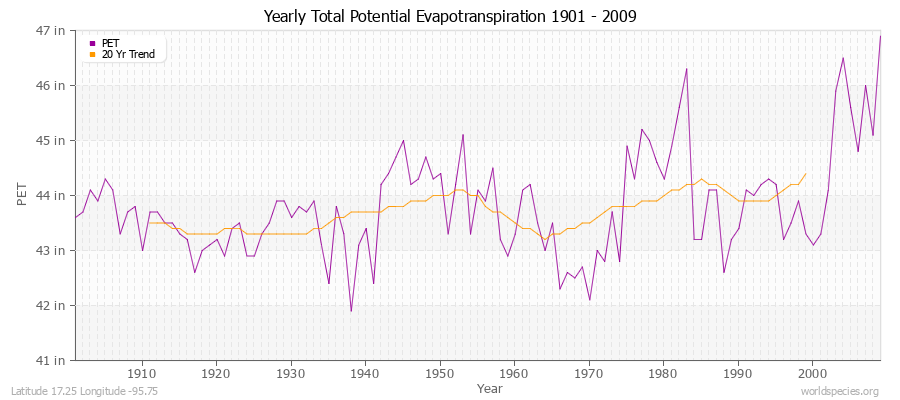
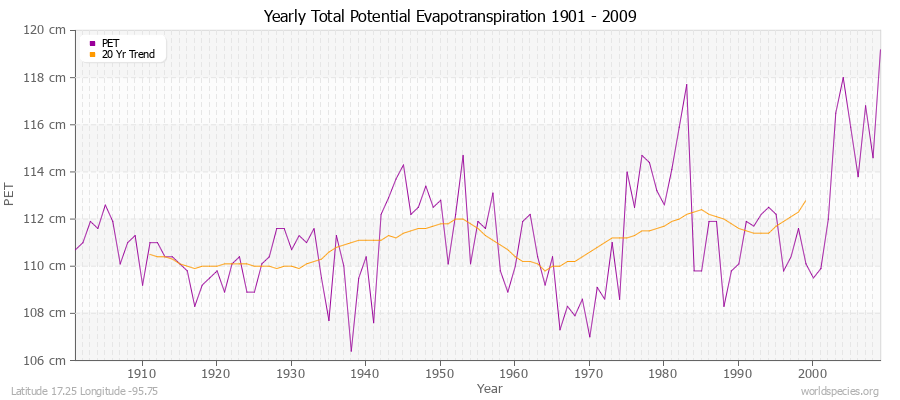
Yearly Total Potential Evapotranspiration 1901 - 2009 (English) Latitude 17.25 Longitude -95.75

Climate data provided by CRU TS 3.1 - University of East Anglia Climate Research Unit (CRU). [Phil Jones, Ian Harris]. CRU Time Series (TS) high resolution gridded datasets, [Internet]. NCAS British Atmospheric Data Centre, 2008, Accessed: 28-July-2011
Charting software provided by pChart - a PHP class to build charts.
Köppen climate classification provided by Kottek, M., J. Grieser, C. Beck, B. Rudolf, and F. Rubel, 2006: World Map of Köppen-Geiger Climate Classification updated. Meteorol. Z., 15, 259-263
The calculation method for the potential evapotranspiration is the FAO grass reference equation (Ekstrom et al., 2007, which is based on Allen et al., 1994). It is a variant of the Penman Monteith method using TMP, TMN, TMX, VAP, CLD.